Private Nail Technician Booking: Hygiene Checks to Make First
A private manicure should feel safer than a salon visit, not riskier. Before you confirm a private nail technician booking, there are specific hygiene checks worth making, from sterilized tools to proper ventilation around gel and acrylic products.
In brief
- 01Single-use or autoclaved tools are non-negotiable; a technician who reuses unsterilized metal implements between clients is a health risk regardless of how polished their work looks.
- 02Gel and acrylic services release vapors that need genuine airflow, not just an open window, so ask how a technician manages ventilation in your home.
- 03UV and LED curing lamps are safe when used correctly, but hands should be shielded or treated with sunscreen, and lamps should be wiped down between uses.
- 04A verified network like ORES screens for licensing, sanitation practices and product sourcing before a professional is ever listed, which removes most of this guesswork for the client.
- 05Discoloration, foul odors, or a technician reluctant to show you sterilized tools are all reasons to end an appointment before it starts.
Key takeaways
- Single-use or autoclaved tools are non-negotiable. A technician who reuses unsterilized metal implements between clients is a health risk, however polished the finished nails look.
- Gel and acrylic services release vapors that need real airflow, not just an open window. Ask how a technician manages ventilation in your home.
- UV and LED curing lamps are considered safe when used correctly. Hands should still be shielded or covered with sunscreen, and lamps should be wiped down between clients.
- A verified network like ORES screens for licensing, sanitation practices and product sourcing before a professional is ever listed, which removes most of this guesswork for you.
- Discoloration, foul odors, or a technician who is reluctant to show you sterilized tools are all reasons to end an appointment before it begins.
Before any private nail technician booking, four hygiene checks matter most. First, every metal tool should be sterilized or brand new for you. Second, the room needs proper airflow for gel or acrylic work. Third, the curing lamp should be clean and used with your skin protected. Fourth, surfaces, files and products should be fresh and free of residue. At ORES, we check these standards before a professional joins our network. The guide below explains each one, so you know what good practice looks like in your own home.
Why Hygiene Matters More at Home Than in a Salon
A manicure is a close, physical service. Cuticle work can break the skin, and a file or nipper that touched another client's hands can carry bacteria or fungus to yours. In a salon, many safeguards are built into the room. At home, the standard depends almost entirely on the person who arrives at your door and what they bring with them.
What a Salon License Normally Covers
Where salons are licensed, the license usually governs the premises as well as the people working there. Inspectors may look at how tools are cleaned and stored, which disinfectants are used, and how equipment is maintained. Some city regulations go into precise detail. Boston's nail salon guidelines, for example, define an autoclave as "an apparatus for sterilization utilizing steam pressure at a specific temperature over a period of time." That definition separates true sterilization from simply wiping a tool down.
Rules differ widely from one country, state and city to the next. Some places license individual technicians, others license salons, and some do both.
What Changes When the Service Comes to You
When a technician travels to you, the salon's inspected room stays behind. What remains is their personal license (where one applies), their kit and their habits. Your living room has no extraction system, no autoclave on the counter and no inspector checking either one.
That is not a reason to avoid at-home beauty services. It is a reason to know what to look for, the same way it matters for other treatments delivered privately, from facials to in-home massage therapy. The convenience is real, and so is the responsibility of choosing the right person.
The Tool Sterilization Checklist for a Private Nail Technician Booking
Tool hygiene is the single most important part of booking a nail technician to come to you. It is also the easiest to verify, because you can see the tools before anyone touches your hands.
Autoclaved Metal Implements vs. Single-Use Tools
Nail tools fall into two groups.
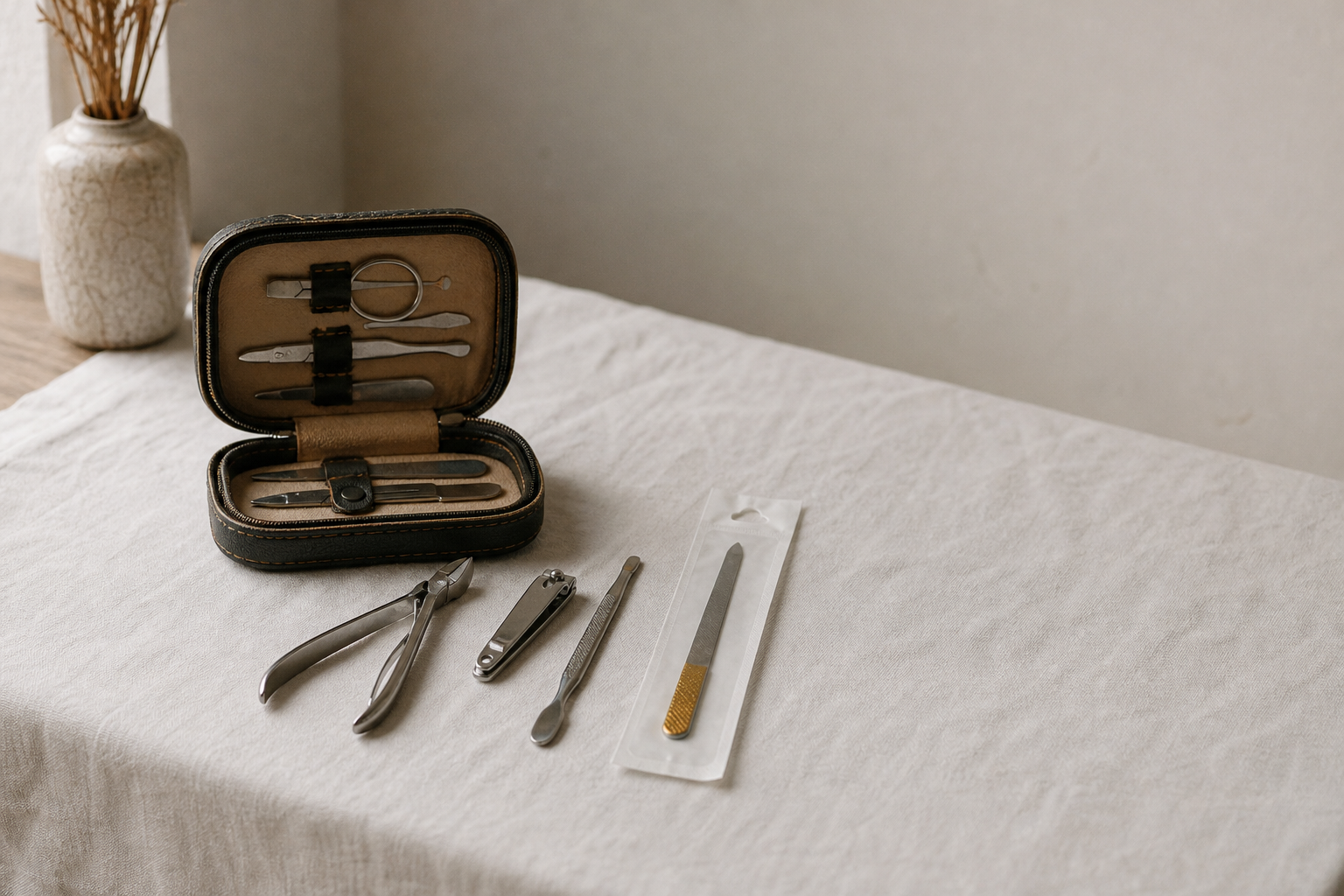
Reusable metal implements include cuticle nippers, pushers and stainless steel files. Good practice is a three-stage sequence before every reuse:
- Mechanical cleaning, scrubbing away visible debris with soap and water.
- Chemical disinfection with a disinfectant registered for that purpose.
- Steam sterilization in an autoclave.
After sterilization, the tools should be sealed in a pouch and opened in front of you.
Single-use items include emery boards, buffers, orange-wood sticks, toe separators and disposable liners. These cannot be properly disinfected because they are porous. They should come out of new packaging and either be thrown away afterward or left with you.
Be aware that a UV "sterilizer" box is not the same as an autoclave. Connecticut's salon infection-control guidance states that such devices "are not acceptable infection control devices and must not be present in a salon," while noting they may serve as a dry storage container. The same guidance adds: "This does not apply to UV dryers or ultraviolet lamps used to dry or cure gel polish." In other words, the lamp that sets your gel is not cleaning anything.
Signs a Technician Is Cutting Corners
Watch for these during setup:
- Metal tools carried loose in a bag, case or roll rather than in sealed pouches.
- Pouches that are already open when the technician arrives.
- Files or buffers with dust, nicks or discoloration from earlier use.
- Rust, residue or dark marks on metal implements.
- A sour or musty smell from the kit, towels or a pedicure basin.
- Unlabeled bottles, or products decanted into plain containers.
- Hesitation or vague answers when you ask how tools are cleaned.
Any one of these is enough to pause the appointment and ask questions. Several together are a reason to stop.
Questions to Ask Before You Book
A good technician will answer these calmly and in detail:
- How are your metal tools cleaned and sterilized between clients?
- Do you open sealed tool pouches in front of the client?
- Which items are single-use, and are they brought new to each appointment?
- Where do you hold your license, and may I see it?
- Which products do you use, and where do you buy them?
A professional with sound practices has no reason to avoid these questions, and they are worth asking of anyone you consider, whichever platform brought you to them.
Ventilation for Gel and Acrylic Services
Classic polish is relatively gentle on a room. Gel and acrylic systems are a different matter, and the home setting makes the difference more noticeable.
Why Gel and Acrylic Vapors Need Airflow
Acrylic work combines a liquid monomer with a powder polymer. The liquid has a strong, distinctive smell and evaporates as the technician works. Gel products, removers and the filing dust from either system add to what lingers in the air. Salons designed for this work often use extraction at the table to pull vapors and dust away from the client and technician. A home living room was not designed with any of this in mind.
What Adequate Ventilation Looks Like in a Home
A single window opened a crack rarely moves enough air. Better arrangements include:
- Cross-ventilation. Open windows or doors on opposite sides of the room so air flows through, not just in.
- A fan pushing air out. A fan placed in a window, facing outward, draws vapors away from the work area.
- A portable nail extractor. Some technicians bring a tabletop unit that captures dust and vapor at the source. Ask whether yours does.
- A larger room. A spacious area with a high ceiling dilutes vapors better than a small, closed space.
Avoid working near open flames or heat sources, and keep children and pets in another room while acrylic or gel is being applied and removed.
Alternatives if a Room Can't Be Ventilated
If no room in your home allows good airflow, there are calmer options. A classic manicure with regular lacquer produces far less vapor. Press-on or soft-gel tips applied with minimal filing reduce dust. You can also schedule acrylic sets for a time when windows can be opened fully. If you are pregnant, have asthma or have a known sensitivity to nail products, speak to your doctor before choosing a service, since that decision depends on your own circumstances.
UV and LED Lamp Safety
Curing lamps cause more confusion than almost any other part of a gel manicure. The evidence calls for care, not alarm.
How Curing Lamps Work
Gel polish contains compounds that harden when exposed to specific wavelengths of ultraviolet light. Traditional UV lamps and newer LED lamps both emit UV light. LED lamps target a narrower band and usually cure faster. Lamps vary considerably in output: a review of nail lamp emissions found that some lamps emitted more UVA than midday summer sun, which is why the choice of lamp matters.
Concern grew after a 2023 laboratory study found that radiation from nail dryers may damage DNA and cause permanent mutations in human cells. That research was carried out on cells in a lab, not on people receiving manicures. MD Anderson Cancer Center's view is that "currently, nail lamps don't appear to be a serious concern for skin cancer risk," while still recommending sensible precautions.
Protecting Your Skin During Curing
MD Anderson advises clients to "protect your skin from UV exposure at the salon by applying sunscreen to any skin exposed to the nail lamp or wearing fingerless gloves." The same applies when the lamp is in your home. Apply a broad-spectrum sunscreen to the backs of your hands beforehand, or ask your technician whether they carry UV-protective fingerless gloves. If you have a history of skin cancer or photosensitivity, ask your dermatologist whether gel services suit you.
Keeping the Lamp Itself Clean
A lamp is touched by every client's hands. Its base and interior should be wiped with a suitable disinfectant before your hands go in. Gel residue on the lamp surface is a sign it has not been cleaned since its last use, and a well-kept lamp also cures more evenly, which helps the finish last.
A Quick Hygiene Checklist Before Every Appointment
Use this table during setup, before any work begins. It brings together everything above for your next appointment.
| Check | What good practice looks like | Red flag |
|---|---|---|
| Metal tools | Sealed sterilization pouches, opened in front of you | Loose tools, open pouches, rust or residue |
| Files and buffers | New, from sealed packaging | Dust, wear marks or discoloration |
| Disinfection | Surfaces and lamp wiped before you sit down | Sticky residue or visible debris |
| License | Shown willingly when asked, where one applies | Vague answers or refusal |
| Products | Labeled, sealed and from known sources | Unlabeled or decanted bottles |
| Ventilation (gel and acrylic) | Cross-airflow, outward fan or portable extractor | Closed room with one window barely open |
| Lamp safety | Sunscreen or fingerless gloves offered | No skin protection discussed |
| Smell | Clean, neutral kit and towels | Musty, sour or foul odors |
If two or more items land in the red-flag column, it is entirely reasonable to end the appointment before it starts.
How ORES Vets Nail Professionals Before They're Listed
Everything above is a lot to assess while someone is unpacking in your hallway. Our role is to do that work in advance, so the person who arrives already meets the standard.
What We Check Before a Profile Goes Live
ORES screens every nail professional before they appear in our network. We review:
- Licensing, checked against the requirements that apply where the professional works.
- Sanitation practices, including how metal tools are cleaned and sterilized and which items are treated as single-use.
- Product sourcing, so that what touches your nails comes from known, reputable suppliers.
Professionals cannot simply list themselves. Those interested can read about how professionals join the ORES network, and only those who meet our criteria are invited in.
Why a Curated Network Removes the Guesswork
An open marketplace shows you who is available. A curated network shows you who has already been checked. That difference changes the experience of a private nail technician booking considerably. You still deserve to see sealed tools and a clean lamp at every visit, and our professionals expect you to look. The difference is that you begin from trust rather than suspicion.
ORES brings a select circle of verified beauty, wellness and lifestyle professionals into your home, so luxury always comes to you. When you are ready, you can book a professional for nails, skincare, massage and more, all delivered privately at home.
Related: How professionals join the ORES network · In-home massage therapy
Good to know
Questions, answered.
It can be, provided the technician uses sterilized or single-use tools, ventilates the room properly and protects your skin during curing. Homes lack salon-style extraction, so airflow needs to be planned rather than assumed. If you have a respiratory condition or are pregnant, check with your doctor before choosing these services.
Licensing rules vary by country, state and city, so start by asking the technician where they are licensed and to show you the document. Where a public licensing board exists, you can often check a license number online. Booking through a verified network like ORES means licensing has been reviewed before the professional is listed.
Disinfecting with a suitable chemical disinfectant reduces germs, but it is not the same as sterilization. An autoclave uses steam under pressure for a set time, which is why it is treated as the benchmark for metal implements. UV "sterilizer" boxes are not a substitute, and the alternative to an autoclave is single-use tools, not a shortcut.
A 2023 lab study found that nail dryer radiation may damage DNA in human cells, which raised understandable concern. MD Anderson Cancer Center's current view is that nail lamps don't appear to be a serious concern for skin cancer risk. It still recommends sunscreen or fingerless gloves during curing, and anyone with a personal history of skin cancer should ask their dermatologist.
Ask calmly how the tools were cleaned and whether sealed alternatives are available. If the answer is unclear, or you see rust, residue or open pouches, you are entitled to end the appointment before it starts. If you booked through a platform, report what you saw so it can be reviewed. For a manicure that meets the same standard as everything else in your home, [book a professional](https://oresglam.com/) through ORES and let us handle the verification.
Book with ORES
Verified professionals, at home.
A select circle of verified professionals, who come to you.
Become a member