
Prenatal Massage at Home: Cost and What to Expect
Prenatal massage at home removes the drive to a spa during pregnancy, but cost and safety both depend on the therapist's training and how the session is set up. Here is what shapes the price and what a verified session actually looks like.
In brief
- 01Prenatal massage at home typically costs more than a standard massage because it requires specialized bolstering, side-lying positioning and a therapist trained in prenatal protocols.
- 02Session length, trimester, and the therapist's prenatal certification are the three factors that most affect what you pay.
- 03A verified therapist will ask about your trimester, any complications and your doctor's clearance before the first session, not after.
- 04ORES recruits and vets professionals, including those trained in prenatal massage, through its own ten-category network rather than open self-listing.
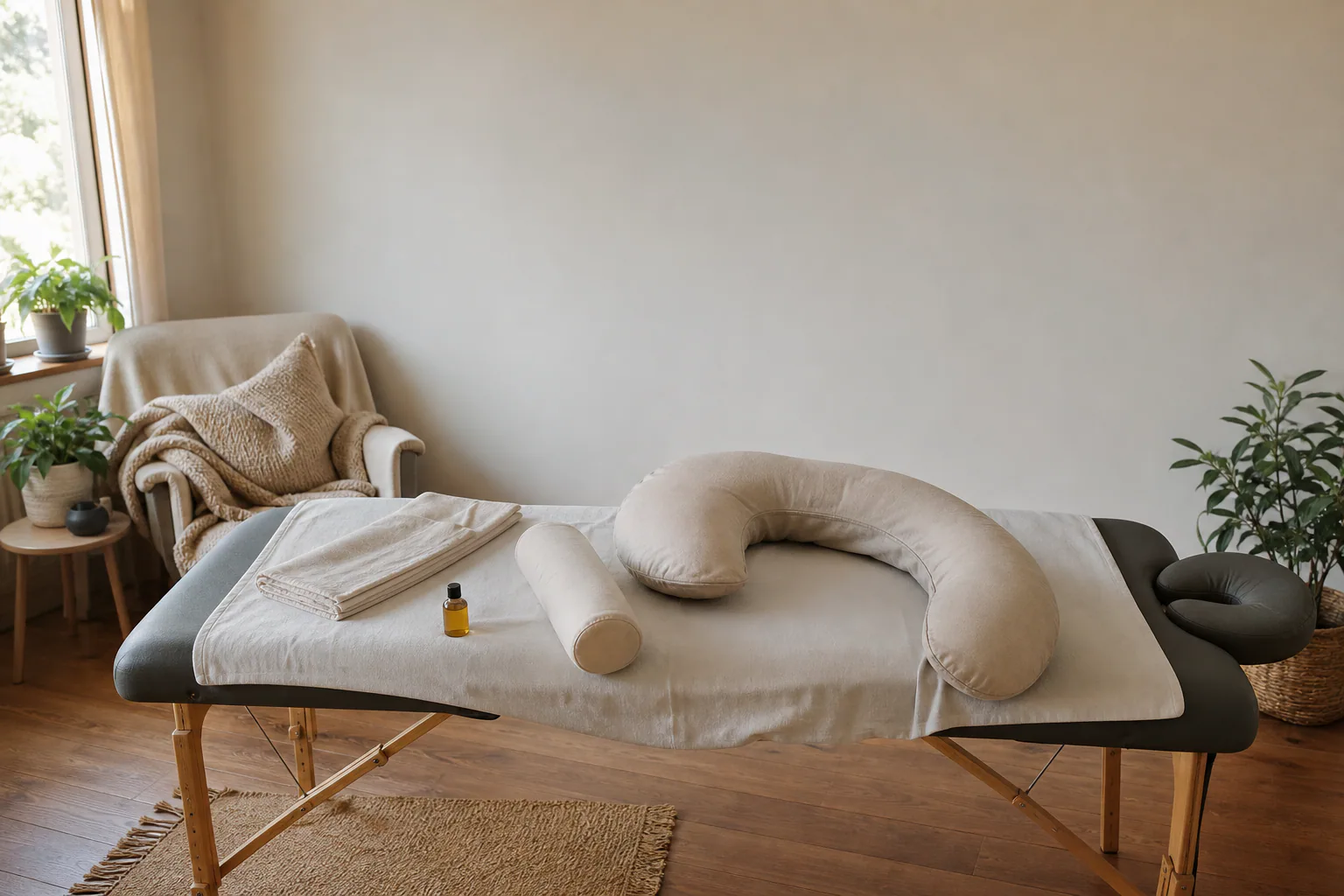
- 05Side-lying positioning with bolster support is the standard approach for pregnancy massage at home, not a table with a belly cutout.
Key takeaways
- A prenatal massage at home typically costs more than a standard home massage, owing to specialized bolstering, side-lying positioning and therapists trained in prenatal protocols.
- Three factors shape most of the price: session length, trimester and the therapist's prenatal certification.
- A properly trained therapist asks about your trimester, any complications and your doctor's clearance before the session begins, not after.
- ORES introduces clients to a vetted circle of wellness professionals, including practitioners trained in prenatal massage, rather than an open, self-listed directory.
- Side-lying positioning with bolster support is the standard approach for pregnancy massage at home. A table with a belly cutout is not.
A prenatal massage at home does not have a fixed, published price. ORES does not list set rates because the right session depends on your trimester, the length of time you book and the therapist matched to you, so cost is confirmed when you book rather than quoted in advance. What tends to shape that figure is practical: the therapist brings bolsters and wedges, works with you lying on your side, and must be trained in prenatal-specific protocols. At ORES, we connect clients with a verified network of wellness practitioners who come to your home, so the investment reflects private, pregnancy-specific care rather than a general spa rate. Below, we walk through what shapes the cost, what a session includes, how to think about safety, and how to book with confidence.
What Drives the Prenatal Massage at Home Cost
A prenatal session is not a standard massage with a few adjustments. It is its own discipline, with its own equipment and training. ORES does not publish a fixed price list for prenatal massage; the cost is confirmed with you at the time of booking, once your therapist, session length and any special requirements are set. For a broader sense of how pricing varies across services, our overview of typical rates across mobile beauty and wellness services places prenatal work in context.
| Cost factor | What it changes | Why it matters in pregnancy |
|---|---|---|
| Session length | Total time the therapist spends with you | Longer sessions mean more hands-on time, though comfort in one position can limit how long feels right |
| Trimester | Setup, positioning and pacing | Later pregnancy usually calls for more bolstering, more repositioning and a slower pace |
| Prenatal certification | The therapist's level of specialized training | Prenatal protocols cover positioning, pressure and contraindications that general training does not |
| Experience | Confidence adapting to your body and history | An experienced therapist adjusts quickly to discomfort or a change in how you feel |
| Equipment | What arrives at your door | Side-lying cushions, wedges and a stable portable table add both setup time and cost |
| Vetted booking | How the therapist is matched to you | A verified, private service involves screening that open listings do not |
Session length and trimester
Session length is the most visible part of the price: more time on the table costs more. In pregnancy, though, the longest session is not always the most comfortable one. As your body changes, remaining in one position for an extended stretch becomes harder, and many clients find a well-paced, slightly shorter session more restful than a long one.
Trimester shapes the work itself. Later pregnancy often calls for more cushions, more frequent repositioning and a slower pace getting on and off the table, which is one reason some therapists price later-trimester sessions differently.
Therapist's prenatal certification and experience
A therapist with dedicated prenatal training has studied how to position, support and adapt a massage for pregnancy. That training, and the experience built on it, carries a higher rate, and it is the part of the price we would least want to see reduced. In prenatal work, skill shows up as judgment: knowing what to ask, what to avoid and when to stop.
Equipment: bolsters, wedges and portable tables
A home prenatal session depends on equipment the therapist brings: body-length bolsters, wedges for the hips and knees, and a sturdy portable table. Transporting, setting up and sanitizing this equipment is part of what you pay for, and it is one reason a luxury wellness concierge service is priced differently from a basic appointment. The experience arrives complete, and is arranged entirely around you.
What a Prenatal Massage Session at Home Actually Includes
Knowing the structure of a session in advance makes it easier to simply relax into it. A well-run prenatal massage at home follows a clear sequence, quite distinct from a standard appointment, as we explain in our comparison of home massage versus a spa visit.
Intake and health questions before the massage begins
Before any massage begins, the therapist should ask about your pregnancy. Expect questions about:
- How many weeks pregnant you are
- Any complications, past or current
- Whether your doctor or midwife has cleared you for massage
- Areas of discomfort, tension or swelling
- Any medications or conditions the therapist should know about
These questions are a mark of professionalism, not a formality. A therapist who skips them is not following prenatal protocols.
Positioning: why side-lying is standard
Most prenatal sessions are done with you lying on your side, supported by bolsters between the knees, under the belly and behind the back. According to The Bump, after the first trimester lying on your side, possibly propped up by pillows, is ideal, since lying on your stomach is no longer comfortable or safe. The same source notes that tables with a belly cutout can still apply pressure to the abdomen, which is why a trained therapist relies on side-lying support rather than a cutout table.
You will usually spend time on one side, then turn with the therapist's help to the other. Some therapists also use a semi-reclined position with careful support, depending on your comfort and stage of pregnancy.
What the therapist focuses on and avoids
A prenatal therapist adapts pressure and technique to pregnancy. Common areas of focus include the shoulders, neck, upper back, hips and feet, where tension often gathers. Prenatal protocols also set limits: firm pressure on the abdomen is avoided, and the therapist adjusts or skips techniques based on your health history. If anything feels wrong, say so; a good therapist will change course immediately.
Is Prenatal Massage Safe During Pregnancy
For many people, prenatal massage can be a comfortable part of a pregnancy routine. Safety still depends on individual health, so treat this section as general information rather than medical advice. On frequency, UT Southwestern Medical Center states that it is "safe to have up to weekly prenatal massages as long as you don't have a condition that could put you or your baby at risk." The condition clause is the essential part of that sentence. Your own situation determines what is right for you.
When to talk to your doctor first
Speak with your doctor or midwife before booking, and especially before your first session. This matters most if you have a high-risk pregnancy, a history of complications, or any condition affecting circulation, blood pressure or the placenta. Your clinician knows your history; a massage therapist does not diagnose and should not be the one deciding whether massage is appropriate for you.
Trimester-specific considerations
Each stage of pregnancy brings different considerations:
- First trimester: Some therapists and practices prefer to wait until after the first trimester before offering prenatal massage. Ask your clinician and your therapist how they approach early pregnancy.
- Second trimester: Side-lying positioning becomes standard, and bolstering grows more important as the belly expands.
- Third trimester: Comfort, repositioning and pacing take priority, and sessions may need more breaks and support.
Warning signs that mean you should reschedule
Contact your doctor or midwife, and postpone the session, if you notice symptoms such as:
- Bleeding or unusual discharge
- Pain, cramping or contractions
- Sudden swelling, severe headache or changes in vision
- Dizziness, fever or feeling generally unwell
- Reduced movement from the baby
A professional therapist will always support rescheduling. Your health comes before any appointment.
Why Verification Matters More for Prenatal Massage Than Any Other Service
With most home services, a weak practitioner means a disappointing result. With prenatal massage, the stakes are personal: you are inviting someone into your home to work with your body at a sensitive time. That is why choosing a verified prenatal massage therapist matters so much.
What prenatal certification should actually cover
Prenatal training should go well beyond general massage. When assessing a therapist, look for training that covers:
- Side-lying and supported positioning through each trimester
- Pressure adaptation and areas to avoid during pregnancy
- Contraindications, and when to decline or pause a session
- Intake procedures, including asking about medical clearance
- Safe handling when helping a client reposition or stand
Ask the therapist directly where and how they trained. A qualified professional will answer clearly and without hesitation.
Why a curated network reduces risk compared to self-listed platforms
On an open marketplace, practitioners largely describe themselves, and the burden of checking credentials falls on you. A curated network works the other way: professionals are reviewed before they are ever offered to a client.
ORES brings a select circle of verified beauty, wellness and lifestyle professionals into your home, including practitioners trained in prenatal massage, so you begin with a vetted starting point rather than an unfiltered list. It does not replace your own judgment or your doctor's advice. It simply gives you a more trustworthy place to start.
How to Prepare Your Home for a Prenatal Massage
A little preparation lets the therapist set up quickly and keeps you comfortable from the start. For general guidance, see our notes on how to prepare your space for in-home spa services. The points below are specific to pregnancy.
Room setup and temperature
- Choose a quiet room with enough floor space for a portable table and room to walk around it.
- Clear the floor of rugs that slip, cables and clutter, so neither you nor the therapist trips.
- Set the room to a temperature that feels comfortable to you; pregnancy can change how warm or cool you feel, so adjust to your own sense of comfort.
- Plan for soft, low lighting and minimal noise. Silence phones and let others in the household know you will be undisturbed.
- Keep a clear, easy path to a bathroom.
What to have ready: pillows, water, a robe
The therapist brings professional bolsters, but a few extra pillows from home can help with fine-tuning. Keep a glass of water nearby for before and after the session, and have a soft robe ready for moving to and from the table, along with loose, comfortable clothing for afterward.
Letting the therapist know about any discomfort in advance
Share relevant details when you book, not only on arrival. Mention any areas of pain, swelling or tension, any positions that feel uncomfortable, and anything your clinician has advised. Advance notice lets the therapist plan the session around you, and you can always add detail during intake or speak up at any moment once the massage begins.
How to Book a Prenatal Massage at Home
When you are ready to book a prenatal massage at home, a short list of questions makes the decision simple. At ORES, booking is available at any hour, so you can arrange your session whenever suits you.
Questions to ask before confirming
Before you confirm, ask:
- What prenatal training does the therapist hold, and where was it completed?
- Will the therapist use side-lying positioning and bring bolsters and wedges?
- Which session lengths are available, and what does each include?
- Will the therapist ask about my trimester, health history and medical clearance beforehand?
- What is the policy if I need to reschedule because of how I feel on the day?
How far in advance to book during pregnancy
Pregnancy is unpredictable, so it helps to build flexibility into your plans. Booking ahead secures a preferred therapist, particularly if you would like continuity of care through your pregnancy. Booking closer to the date lets you judge how you feel in the moment. Many clients do both: they keep a regular slot and adjust it when needed, which our on-demand booking is designed to support.
Good to know
Questions, answered.
According to [UT Southwestern Medical Center](https://utswmed.org/medblog/massage-pregnancy-guidelines/), it is "safe to have up to weekly prenatal massages as long as you don't have a condition that could put you or your baby at risk." Whether that frequency suits you depends on your health and history, so ask your doctor or midwife what is appropriate for your pregnancy.
This is a common concern, and the safest course is to raise it with your doctor or midwife, particularly as your due date approaches. A trained prenatal therapist follows protocols that avoid firm abdominal pressure and adapts the session to your stage of pregnancy. If you have any signs of labor or contractions, postpone the session and contact your clinician.
Side-lying with pillow or bolster support is the standard position. [The Bump](https://www.thebump.com/a/prenatal-massage-safety) notes that after the first trimester, lying on your side is ideal, since lying on your stomach is no longer comfortable or safe. Tables with a belly cutout can still put pressure on the abdomen, which is why trained therapists rely on side-lying support instead.
Speaking with your doctor or midwife first is the most prudent step, especially if your pregnancy is high-risk or involves complications. A verified therapist will ask whether you have medical clearance during intake, but your clinician, not the therapist, is the right person to judge whether massage suits your situation.
Approaches to the first trimester vary, and some therapists prefer to wait until after it before offering prenatal massage. Your doctor or midwife can advise based on your health. If you do book early in pregnancy, tell the therapist how many weeks along you are so they can adapt the session.
According to the [American Institute of Alternative Medicine](https://www.aiam.edu/massage-therapy/prenatal-massage/), prenatal massage sessions typically run 60 to 90 minutes, with shorter 30-minute sessions sometimes arranged. Later in pregnancy, some clients prefer the shorter option, since holding one position becomes less comfortable. Discuss which length suits you with your therapist when you book. Ready to arrange a verified prenatal massage therapist for your home? [Book a professional](https://oresglam.com/) through ORES and let luxury come to you.
Book with ORES
Verified professionals, at home.
A select circle of verified professionals, who come to you.
Become a member