Home Facial vs Spa Facial: Which Gives Better Results
The results of a facial come down to the skill of the esthetician and the quality of the products, not the address where the treatment happens. Here is how a home facial and a spa facial actually compare.

In brief
- 01A facial's results depend more on the esthetician's skill and product quality than on whether it happens at a spa or at home.
- 02Spa facials offer access to fixed equipment like steam rooms and hydrafacial machines, while home facials offer full privacy and one-on-one focus without travel.
- 03Verified at-home providers, like those vetted through ORES, can bring professional-grade tools and products to match much of what a spa offers.
- 04Home facials remove the shared-space hygiene variables of a spa, since tools and linens are set up fresh for a single client.
- 05The better choice depends on whether your priority is specialized equipment, privacy, convenience, or a combination booked alongside other services.
Key takeaways
- A facial's results depend more on the esthetician's skill and the quality of the products used than on whether the treatment happens at a spa or at home.
- Spas offer fixed equipment such as steam rooms and HydraFacial machines. Home facials offer privacy and undivided attention, with no travel required.
- Verified at-home estheticians, like those vetted through ORES, bring professional-grade tools and products that match much of what a spa provides.
- A home setting removes the shared-space variables of a spa, since tools and linens are prepared fresh for a single client.
- The better choice comes down to what you value most: specialized equipment, privacy, convenience, or a facial paired with other services.
Which Gives Better Results: The Short Answer
When it comes to home facial vs spa facial, neither setting is inherently superior. Results come from three things: the skill of the esthetician, the quality of the products, and how well the treatment is matched to your skin. A highly skilled esthetician working with professional-grade products will deliver better results in your own home than an average one will in an elegantly designed treatment room.
The spa holds a real advantage in one respect: large, fixed machinery. Home holds the advantage in privacy, undivided attention, and the absence of travel. At ORES, we connect clients with a curated circle of verified estheticians who bring the facial to them, so the decision becomes less about location and more about finding the right professional for your skin.
Consistency also matters more than any single appointment. One 2026 comparison found that the results of a standard spa facial last roughly one to two weeks, compared with four to twelve weeks for medical-grade facials. Whichever setting you choose, a steady rhythm with a trusted practitioner is what produces skin that visibly improves over time.
What a Spa Facial Delivers
A well-run spa offers a complete environment. The facial is often one part of a wider ritual: a robe, a relaxation lounge, perhaps a steam room or sauna, and a calm space to linger afterward. For many clients, that atmosphere is part of the value.
Spa menus tend to be broad. A single facility may offer basic, signature, and luxury facials alongside machine-based treatments, all under one roof.
Equipment a Spa Keeps On-Site
The clearest advantage of a spa is equipment that does not travel. Steam rooms, full HydraFacial systems, and larger multifunction machines are built into the treatment space or are too heavy and costly to move. If the treatment you want depends on one of these machines, a spa is the natural place for it.
That equipment is reflected in the price. Standard day-spa facials typically run $75 to $175 per session, with HydraFacials and other advanced treatments reaching $150 to $350. A separate analysis of real spa menus found a median facial price of $125, with a typical range of $85 to $170.
The Shared-Space Trade-Off
A spa is, by design, a shared space. Treatment rooms turn over between clients throughout the day, and common areas such as changing rooms and lounges serve everyone. Reputable spas manage this with care, yet these remain variables outside your control.
There are practical trade-offs too. You travel there and back, often with freshly treated skin and no makeup. Your appointment sits within a fixed slot in the spa's schedule, so the pace is set by the next booking rather than by your skin. After extractions or a peel, you return to the outside world before your skin has had time to settle.
What a Home Facial Delivers
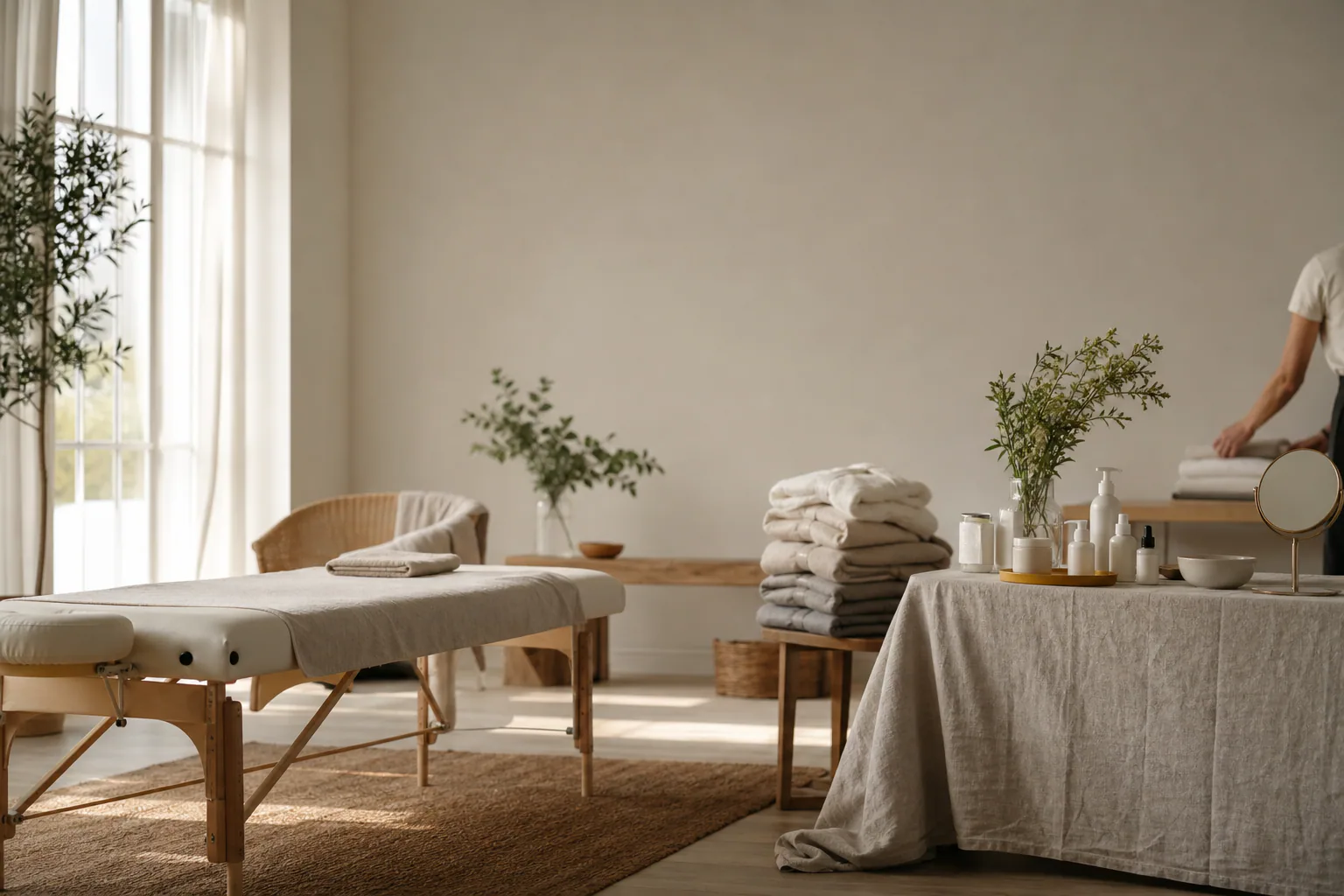
A home facial brings the treatment room to you. The esthetician arrives with their tools, products, and treatment bed, sets up in a quiet room of your choosing, and works with you alone from start to finish.
What a Verified Esthetician Brings to Your Home
Portable professional equipment has advanced considerably. Mobile estheticians can work with compact devices such as microneedling pens, LED therapy devices, ultrasonic skin scrubbers, high-frequency devices, and multifunction facial systems, allowing them to offer many popular facial treatments without large, fixed machines.
The treatment bed travels as well. A portable facial bed is a lightweight, foldable table that typically weighs between 25 and 50 pounds and folds into a compact carrying case. With fresh linens, a professional product range, and good lighting, a home visit can reproduce much of what a spa treatment room offers.
What any esthetician can offer depends on their training and credentials, which is why verification matters. Through ORES, you book from a vetted network rather than an open listing, so the professional who arrives has already been checked. If you are weighing the investment, what shapes the price of a private facial at home comes down to the practitioner, the treatment, and the length of the visit.
Privacy and Pacing Without a Clock Running
Privacy changes the experience in quiet but meaningful ways. There is no waiting room, no shared changing area, and no one sees your skin in the hours after extractions. Afterward, you rest in your own space rather than driving home.
Pacing changes too. With one client and no next room to prepare, the esthetician can give your skin full attention, adjust the treatment as they go, and explain what they see. That one-on-one focus is often what turns a pleasant facial into an effective one. Booking through ORES can be arranged at any hour, so the appointment fits your day rather than the other way around.
Home Facial vs Spa Facial: Side-by-Side
For a quick home facial vs spa facial comparison, here is how the two settings line up on the factors most clients weigh before booking.
| Factor | Spa facial | Home facial |
|---|---|---|
| What drives results | Esthetician skill and product quality | Esthetician skill and product quality |
| Equipment | Fixed machines, steam rooms, full HydraFacial systems | Portable professional devices such as LED, ultrasonic, and high-frequency tools |
| Privacy | Private treatment room, shared common areas | Complete privacy in your own home |
| Travel | Required before and after the treatment | None |
| Hygiene setup | Room turned over between clients | Tools and linens set up fresh for one client |
| Pacing | Fixed slot within the spa's schedule | Set around a single client |
| Atmosphere | Designed environment with amenities | Your own space, arranged as you like |
| Pairing with other services | Other treatments on the spa menu | Massage, hair, or makeup booked for the same visit |
| Typical price | [Median of $125 per facial](https://spadayfinder.com/price-index/) | Varies by practitioner and treatment |
The same logic applies across wellness services. If massage is part of your routine as well, the trade-offs between a home massage and a spa visit follow much the same reasoning as facials.
When a Spa Facial Is the Better Choice
A spa is the right call in several situations, and it is worth being clear about them.
- You want a machine-based treatment. If you have your heart set on a full HydraFacial or another treatment tied to large equipment, a spa is equipped for it.
- You want the full day. Steam rooms, saunas, pools, and lounges are part of what you are paying for, and a home visit does not replicate them.
- Leaving the house is part of the pleasure. For some clients, the journey and the change of scene are the point.
- Your home lacks a calm room. A facial needs a quiet space with room for a treatment bed. If that is difficult to arrange, the spa removes the problem.
None of these is about results alone. They are about equipment, setting, and preference, and each is a perfectly good reason to choose a spa.
When a Home Facial Is the Better Choice
Home comes out ahead when your priorities are privacy, time, and consistency.
- Privacy matters to you. You prefer that no one sees you before or after treatment.
- Your time is limited. Removing travel from both ends of the appointment makes a regular facial far easier to sustain.
- You want consistency. Board-certified dermatologist Blair Murphy Rose suggests a good guideline is "to have four to twelve facials a year, ranging from quarterly to monthly". A home routine is easier to maintain at that rhythm.
- You want to rest afterward. After extractions or an active treatment, staying home lets your skin settle before it meets makeup, sun, or a commute.
- You want to pair services. A facial can be booked alongside a massage, a blow-dry, or makeup for an evening out, all in one visit.
- You want the same practitioner each time. Seeing one esthetician regularly means they come to know your skin and adjust each treatment accordingly.
If you are not yet sure which treatment suits your skin, an at-home skincare consultation is a considered first step before committing to a series of facials.
How to Choose Between Them
Start by ranking what matters most to you. If one specific machine-based treatment is non-negotiable, book a spa. If privacy, time, and a steady routine come first, a home facial will serve you better. Many clients use both: a home facial as the regular foundation, and an occasional spa visit for a specific treatment or a day of rest.
Whichever setting you choose, the practitioner matters most. Look for clear training, credentials, and a transparent process for how products and devices are chosen for your skin before you book.
Questions to Ask Before You Book Either Option
- What are the esthetician's training and credentials? Ask what they are qualified to perform, particularly for active treatments.
- Which products and devices will they use? Professional-grade products and well-maintained tools matter more than the room.
- Is the treatment suited to your skin type and goals? A good esthetician will ask about your skin before recommending anything.
- How are tools and linens prepared? You should know how equipment is cleaned and whether linens are fresh for you.
- How long is the treatment itself? Compare the time actually spent on your skin, not the length of the booking.
- How often should you return? A practitioner should suggest a rhythm, not just a single appointment.
- Can other services be added? If you want a massage or styling the same day, check whether it can be arranged in one visit.
When the answers point toward home, booking through ORES puts those questions in capable hands. Every professional in our network has been verified before joining, and you can arrange a facial on its own or as part of a longer visit.
Related: What a private facial really costs at home · How to choose a top rated beauty service at home · Comparison of home massage vs a spa visit
Good to know
Questions, answered.
Yes, when the esthetician is skilled and uses professional-grade products. Results depend on the practitioner and the treatment rather than the room. The main exception is a treatment that requires large, fixed equipment, which is better suited to a spa.
Spa facials have a [median price of $125, with a typical range of $85 to $170](https://spadayfinder.com/price-index/), while advanced treatments can cost more. At-home pricing varies by practitioner, treatment, and length of visit.
Mobile estheticians can bring [compact professional devices such as LED therapy devices, ultrasonic skin scrubbers, high-frequency devices, and multifunction facial systems](https://glownar.com/collections/homeuse). They also bring a portable treatment bed, linens, and their professional product range. What they can offer depends on their training and credentials.
Board-certified dermatologist Blair Murphy Rose suggests [four to twelve facials a year, ranging from quarterly to monthly](https://www.theskimm.com/beauty/skin-care/how-often-should-you-get-a-facial). Stronger treatments need longer gaps; light chemical peels, for example, are [often done as a series of three to five treatments spaced two to five weeks apart](https://facialadviser.com/how-often-should-you-get-a-professional-facial/). Your esthetician can recommend a rhythm suited to your skin.
Yes. Because ORES covers beauty and wellness across several disciplines, you can arrange a facial alongside a massage in the same visit, all in the comfort of home. Ready to see for yourself? [Book a verified esthetician through ORES](https://oresglam.com/) and bring the facial home.
Book with ORES
Verified professionals, at home.
A select circle of verified professionals, who come to you.
Become a member